Back to list

When Optimisation Is No Longer Enough: The Design Limits of Corporate Accommodation
Corporate accommodation programmes have invested heavily in optimisation – introducing more reporting, greater oversight, and increased sourcing effort. However, despite these advances, recurring structural friction persists. This raises an important question: has the industry reached the design limits of its current architecture?
A Pattern That Can No Longer Be Ignored
Over the past eight weeks, we have explored recurring structural tensions within corporate accommodation. Notably, several themes have emerged consistently across both buyer and hotel perspectives:
-
Reporting increases without strengthening confidence
-
Data fragmentation requiring manual reconciliation
-
Annual sourcing cycles misaligned with dynamic markets
-
Leakage reframed as a design issue rather than compliance
-
Rate integrity failures undermining programme credibility
-
Buyers facing growing internal pressure
-
Insight arriving too late to influence decisions
-
Ecosystem definitions that fail to fully align
At first glance, each issue appears manageable. However, when viewed collectively, they reveal a broader systemic pattern.
Why Optimisation Has Been the Default Response
When friction appears, the industry’s response has typically been logical and well-intentioned. For example, organisations often:
-
Increase reporting frequency – despite the timing gap previously examined in our analysis of why reporting fails to support real-time decision making
-
Add additional oversight checkpoints
-
Expand sourcing scrutiny
-
Strengthen policy enforcement
-
Layer in new tools or manual review processes
While these actions are not misguided, and often stabilise performance in the short term, they share a critical limitation. Specifically, they operate within the existing architectural framework.
In other words, optimisation improves what already exists — but it does not fundamentally change what the structure was designed to support.
Understanding the System’s Design Rhythm
Every system operates within a defined rhythm. In corporate accommodation, this rhythm reflects the cadence and assumptions embedded in programme infrastructure — including sourcing cycles, reporting timelines, and data flows.
Historically, this infrastructure evolved around several key assumptions:
- Annual commercial cadence – as explored in our examination of the structural limits of the annual RFP cycle
-
Batch-based reporting cycles
-
Moderate data complexity
-
Limited internal scrutiny beyond procurement and travel teams
At the time, this design was sufficient. However, the market environment has since evolved significantly.
Today:
-
Demand patterns shift monthly
-
Rate structures adjust dynamically
-
Stakeholders expect near real-time visibility
-
Distribution ecosystems have grown more complex
As a result, while the market has accelerated, the underlying architecture has remained largely unchanged.
A Practical Example of Structural Strain
To illustrate this misalignment, consider a common sequence:
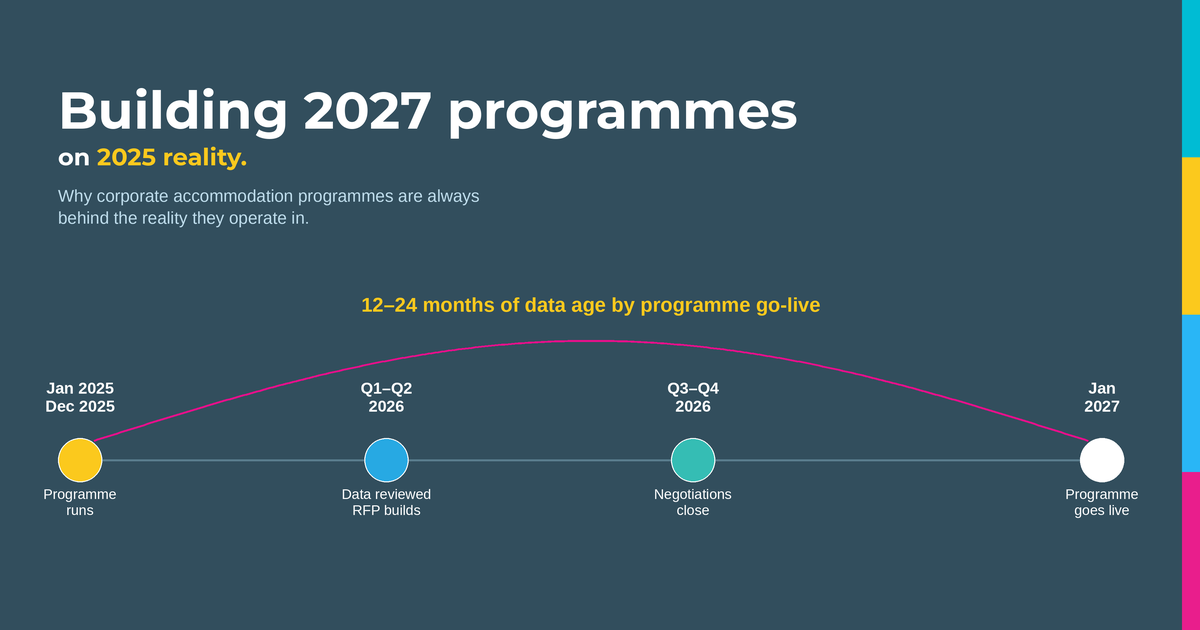
A rate is negotiated during the annual sourcing cycle in October.
By February, dynamic pricing and availability controls begin influencing booking behaviour.
Then, the impact becomes visible in April reporting.
Subsequently, discussions take place in June.
Finally, adjustments are deferred to the next sourcing cycle.
Importantly, no participant has acted incorrectly, and no single system has failed. Nevertheless, the structure itself delays meaningful correction.
Therefore, the issue is not behavioural — it is architectural.
When Optimisation Stops Delivering Results
As complexity increases, organisations often respond by adding more effort. For instance:
-
More reconciliation
-
More frequent reviews
-
More manual validation
However, although these measures absorb time and attention, they do not eliminate the structural lag embedded in the system.
Consequently, the recurring challenges discussed throughout this series should not be viewed as isolated operational weaknesses. Instead, they are indicators that the current design is operating at the edge of its intended capacity.
At this point, when incremental optimisation yields diminishing returns, the constraint is no longer procedural — it is structural.
The Strategic Question Ahead
Over the past decade, corporate accommodation has matured considerably. Technology has advanced, data volumes have expanded, and oversight has intensified.
Even so, the core cadence of programme management remains anchored to assumptions formed in a very different market environment.
Now that these structural constraints are increasingly visible, the critical question is no longer how to optimise within them.
Rather, the industry must ask whether the architecture itself needs to be rethought.