Back to list

Why Corporate Accommodation Programmes Are Always Behind Reality
For most corporate accommodation programmes, everything starts with data.
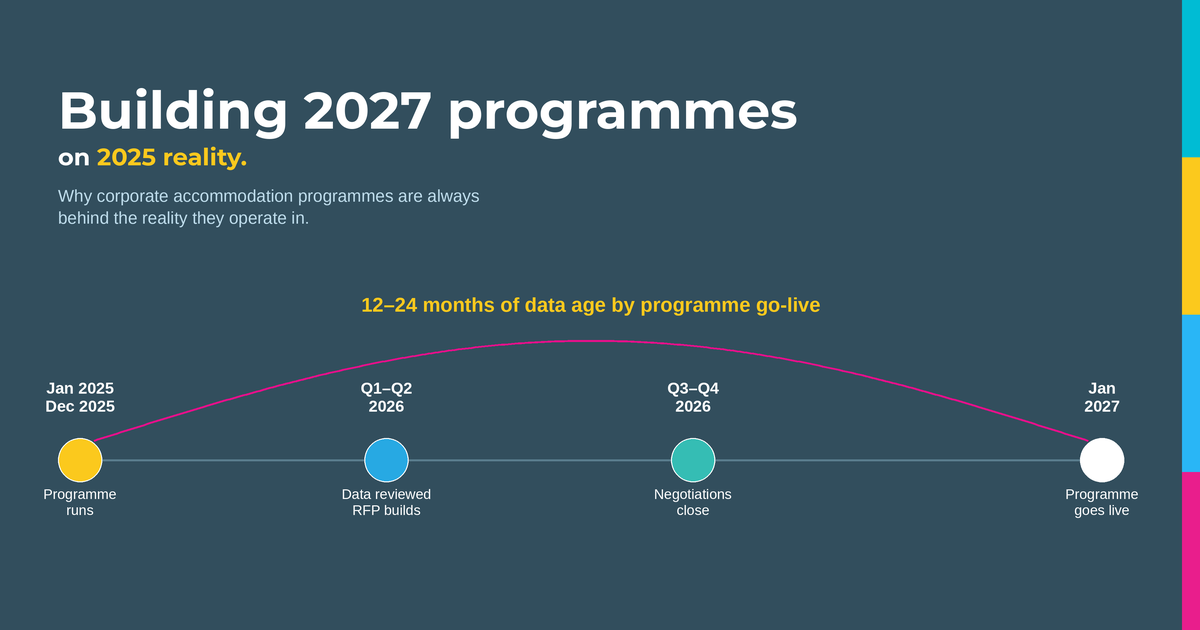
If you’re following a typical hotel RFP cycle, that usually means reviewing the previous year’s spend somewhere around the end of Q1 or early Q2.
From there, the process follows a familiar rhythm. Data gets analysed, the next sourcing cycle begins to take shape, RFPs build through the summer, and negotiations extend into the second half of the year. By January, a new programme is in place.
On paper, it’s a clear and logical sequence. But when you pause on one detail — the timing of that data — a different question starts to emerge.
How Old Is the Data We’re Actually Using to Make Decisions?
Take a typical example.
A programme runs from January to December 2025. That data is reviewed in Q1 or Q2 of 2026. At that point, the earliest data points are already over a year old, and even the most recent are a few months behind.
By the time the RFP begins mid-year, the dataset has aged further. As negotiations continue through the rest of the year, the gap quietly widens.
So when the new programme goes live in January 2027, something quite easy to overlook has already happened: many of the decisions shaping it are based on data that is between 12 and 24 months old.
What Does That Mean for How Programmes Behave?
This doesn’t mean the data is wrong. But it does change what the programme is anchored to.
In a market where pricing moves daily, availability shifts constantly, and traveller behaviour evolves over time, even small delays begin to matter. What emerges is a subtle misalignment.
The programme reflects what was true, while the market continues to move.
As explored in our previous blog, Corporate Accommodation Programmes Are Continuous — Not Cyclical, that movement isn’t occasional. It’s continuous.
Why Is This Gap Becoming Easier to See?
In many ways, this gap has always existed. What’s changing is its visibility.
Programmes are being managed more actively. Hotel pricing and distribution are becoming more dynamic. Expectations around visibility are increasing.
As discussed in our last blog, Why Does Accommodation Data So Often Arrive Too Late to Matter?, the challenge isn’t just the availability of data — it’s when that data arrives relative to the decisions being made.
When those two elements fall out of sync, the effects start to show.
How Do Programmes Continue to Function?
Interestingly, programmes don’t stop working. They adapt.
Buyers begin to sense-check availability more frequently. Hotels validate and adjust distribution in real time. Teams compare multiple data sources to build a clearer picture.
Over time, this becomes part of the operating rhythm — not because it was designed that way, but because it needs to be.
This begins to shift how we interpret what’s happening:
manual effort isn’t simply inefficiency, it’s often a signal that the structure around the programme isn’t keeping pace.
Is This Just a Data Timing Issue?
At first glance, it can look like one. But the pattern runs deeper.
The lifecycle itself is built on a sequence where:
- data is collected after the fact
- decisions are made later
- programmes are implemented later still
Each step introduces a delay. Those delays don’t sit in isolation — they compound.
What begins as a timing gap gradually becomes something more structural: a programme that is consistently slightly behind the environment it operates in.
What Impact Does That Have on Programme Performance?
Over time, the effects become familiar.
Rates don’t always align with current conditions. Availability behaves differently than expected. Performance becomes harder to explain with confidence. Internal conversations become more reactive.
Not because something has gone wrong, but because the programme is trying to keep pace with a moving environment using a delayed reference point.
Where Does That Leave the RFP?
The RFP still plays an important role. It defines direction, sets expectations, and establishes the framework for the programme.
But it wasn’t designed to operate on delayed intelligence in a continuously moving environment. As that environment becomes more dynamic, the tension becomes more noticeable.
The question begins to shift. Not just “How do we improve the RFP?”, but how we reduce the distance between reality and the decisions being made.
Is This About Changing the Process—or Changing Perspective?
This isn’t necessarily about replacing anything. It’s about recognising what sits around the process.
The challenge isn’t only how programmes are sourced. It’s how they stay aligned once they’re live.
That leads to a quieter shift in thinking: access to data on its own is no longer enough. Timing — and alignment to decision-making — matters just as much.
Why Is This Becoming More Relevant Now?
The industry hasn’t changed overnight. But expectations have.
Programmes are expected to be managed more continuously. Hotels are operating with increasingly dynamic models. Stakeholders expect clearer, more timely insight.
Yet much of the underlying structure remains the same. The result is a gap that becomes easier to feel — not as failure, but as gradual drift between the programme and the reality it’s trying to reflect.
What Happens If That Gap Starts to Close?
This is where the conversation begins to open up.
Once the gap becomes visible, a different question naturally follows: what would it look like if decisions were made closer to the moment they matter?
Not after the fact. Not months later. But in step with how the programme is actually behaving.
That question doesn’t replace the RFP. But it does begin to reshape how we think about everything around it — and how corporate accommodation programmes might evolve from here.