Back to list

Shared Definitions, Fragmented Signals: The Structural Barrier to Decision-Time Visibility
Decision-time visibility does not emerge from isolated systems. This article explains why corporate accommodation visibility is an ecosystem property — and why misaligned definitions and signal ownership continue to block alignment.
Why Visibility Cannot Be Produced in Isolation
In corporate accommodation, ecosystem alignment means that buyers, hotels, intermediaries, and distribution systems interpret bookings, rates, and performance signals consistently — without redefining them at every handoff.
Across the ecosystem, participants share a common goal: clearer performance insight, earlier signal detection, and stronger confidence in negotiated value.
However, each participant focuses on improving visibility within their own layer of the accommodation chain:
-
Hotels optimise revenue systems
-
TMCs refine booking data flow
-
Buyers enhance reporting frameworks
-
Payment providers strengthen transaction clarity
Local optimisation is widespread and effective.
Yet decision-time visibility remains elusive. As outlined in our examination of decision-time visibility and the limits of retrospective reporting, timing alignment alone does not resolve cross-system misalignment.
Local Clarity vs Shared Visibility
Visibility inside a single system does not create ecosystem alignment.
Instead, each layer of the corporate accommodation environment operates with its own:
-
Definitions
-
Data structures
-
Performance metrics
-
Reporting cadence
These definitions work well internally but fail to align across systems.
For example, a hotel property management system may classify a booking one way, while a distribution platform categorises it differently. Similarly, one dataset may retain a cancelled reservation while another removes it entirely. Payment data may also fail to match recorded stay data.
No participant is misreporting. Each one operates within its own definitional framework.
As a result, fragmentation is structural — not adversarial.
The Shared Definition Problem
Decision-time visibility depends on consistent answers to key questions:
-
What qualifies as a booking?
-
When does a stay count toward negotiated volume?
-
How should systems define leakage?
-
When is rate performance compliant?
Even small differences in these definitions distort signals as they move through the ecosystem.
Each participant may trust their own data. However, collective alignment weakens when definitions diverge.
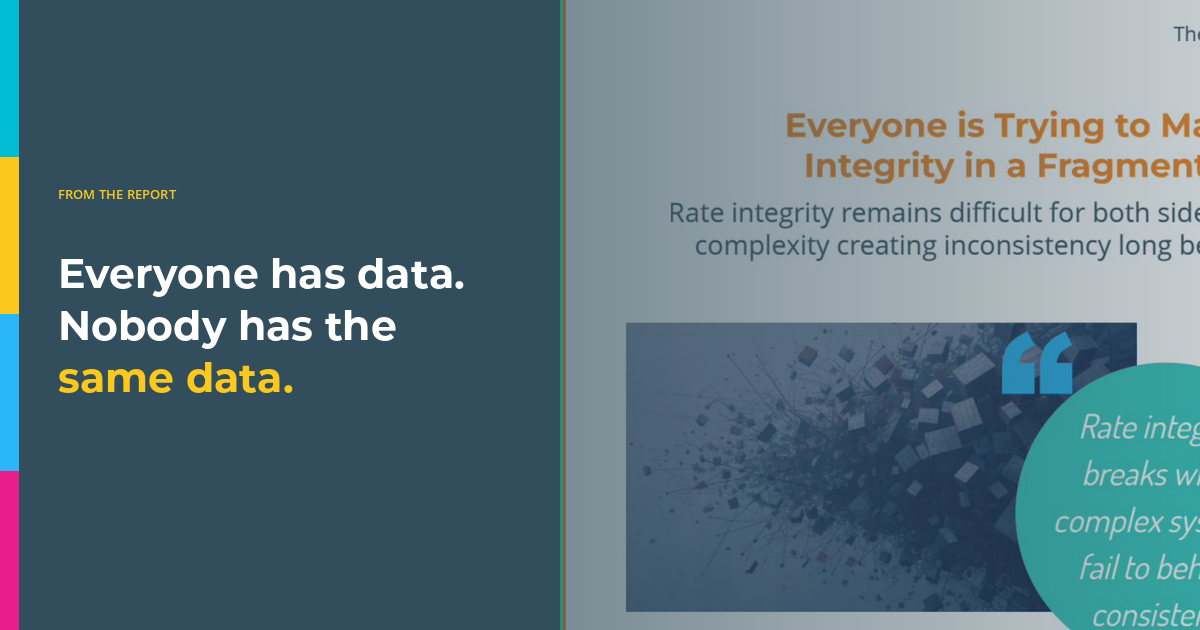
The core issue is not data quantity — it is signal coherence.
Why More Data Doesn’t Solve the Problem
The corporate accommodation ecosystem does not lack data. Instead, it lacks uninterrupted signal flow.
When information passes through multiple independent systems, it is interpreted before it is shared. This dynamic builds on the fragmented data environments examined earlier in our analysis of the disconnected data problem in corporate accommodation. Fields are reformatted. Categories are adjusted. Timelines are reconciled to local cadence.
Consequently, aggregated visibility reflects multiple layers of interpretation rather than a shared definition.
This outcome does not result from poor execution. It stems from the nature of distributed system architecture.
Why Visibility Is an Ecosystem Property
Decision-time visibility requires signals that retain their meaning as they move across systems.
No single stakeholder can achieve this alone:
-
Buyers cannot create ecosystem alignment independently
-
Hotels cannot ensure downstream signal integrity
-
Intermediaries do not control every definitional layer
True visibility must emerge from shared architectural principles.
Until stakeholders align definitions and allow signals to flow without reinterpretation, visibility will remain inconsistent — regardless of reporting frequency.
Conclusion: Reframing the Visibility Challenge
The barrier to decision-time visibility is not technology or intent.
Instead, definitional misalignment across a layered ecosystem prevents progress.
The path forward is becoming clearer. However, coordination across stakeholders has yet to follow.
Recognising visibility as an ecosystem property — rather than a reporting output — shifts the conversation away from blame and toward structural change.
It also highlights what must happen before the industry can restore confidence at scale.
The State of Corporate Accommodation captures this tension directly and reflects growing readiness for alignment — even if alignment has not yet begun.