Back to list

Corporate Accommodation Programmes Are Continuous — Not Cyclical
There is a widely accepted assumption within corporate accommodation programmes.
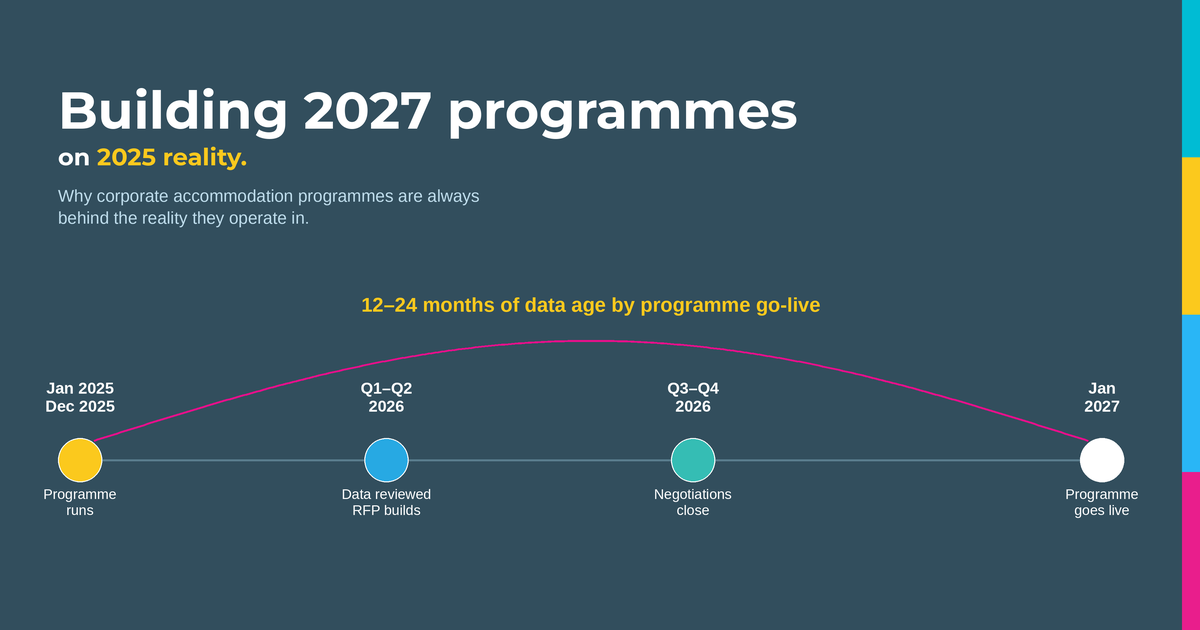
Many believe these programmes operate in defined stages. Sourcing takes place once a year. Hotel RFPs are completed. Rates are agreed. Programme data is reviewed periodically, and adjustments follow only when issues arise.
On the surface, this appears structured. However, this model does not reflect how corporate accommodation programmes actually behave.
Programmes Operate Continuously — Not in Phases
In reality, accommodation programmes do not pause between sourcing cycles. Instead, they operate continuously.
Rates shift daily, while availability changes in real time. At the same time, traveller behaviour evolves week by week, and programme data flows across multiple systems that often fail to align.
As a result, this is not a process revisited occasionally. It is an environment that teams operate within at all times.
Yet despite this, many corporate travel programmes are still managed as if they are static.
The Structural Gap in Corporate Accommodation
This disconnect is not caused by a lack of capability. Rather, it reflects a structural gap within corporate accommodation programmes.
On one side, buyers are expected to deliver more frequent and more detailed insight, often without full programme visibility. On the other, hotels must manage increasing complexity across pricing, distribution, and corporate demand, typically through fragmented systems.
Consequently, both sides operate using different versions of the same programme reality.
Across the industry, several patterns consistently emerge:
- No single source of truth
- Conflicting accommodation programme data
- Manual reconciliation as standard practice
- Programme insight arriving after decisions are made
In response, teams adapt. They build workarounds, cross-check reports, and validate data that should already be reliable.
Importantly, this behaviour is not a preference. It is a response to structural limitations within the programme itself.
More Data Does Not Mean More Visibility
There is no shortage of data in corporate accommodation. If anything, the volume continues to increase. However, more data has not led to greater control. Instead, it has introduced additional responsibility.
Teams must validate more reports, resolve more discrepancies, and spend more time aligning data before taking action.
Therefore, the challenge is not access to data. The challenge is the absence of connected programme intelligence.
Without alignment across sourcing, booking, and performance, data becomes fragmented. As a result, information creates noise rather than insight.
From Process Thinking to Programme Intelligence
This shift changes how corporate accommodation programmes should be understood. Rather than treating accommodation as a process that runs annually, organisations must recognise it as a continuously managed system.
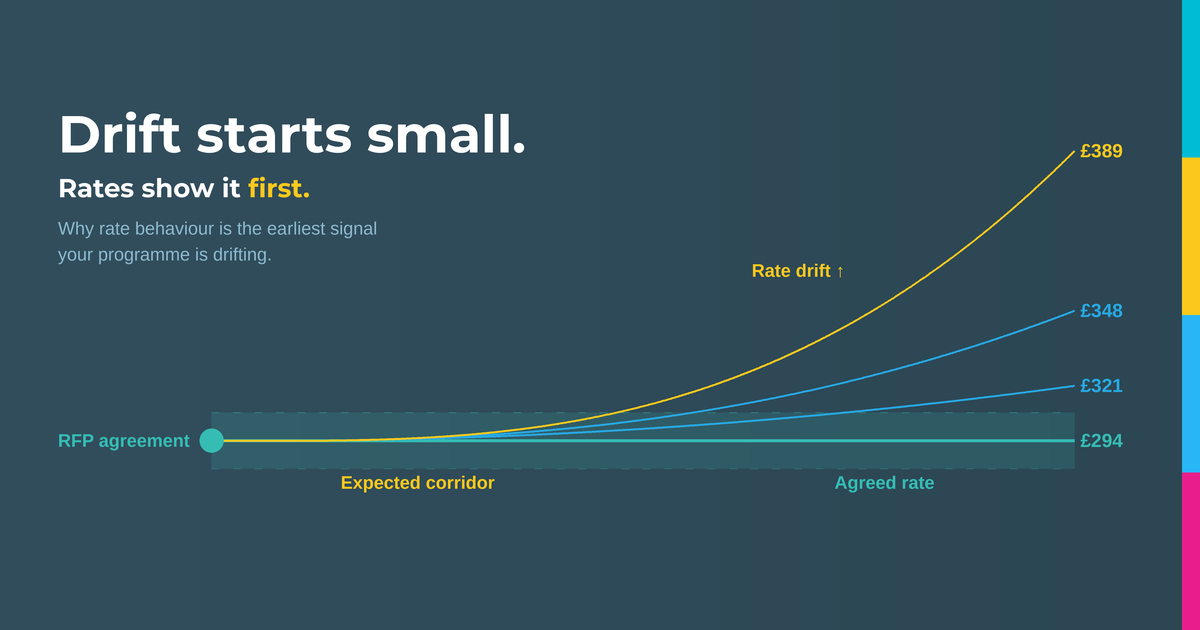
This includes monitoring performance, tracking rate behaviour, adjusting supply, and responding dynamically across the programme lifecycle.
Consequently, the core question evolves. It is no longer: “How do we improve our hotel RFP process?”
Instead, it becomes: “How do we create continuous visibility across the accommodation programme?”
What Becomes Possible with Programme Intelligence
When programme data is connected and aligned, new opportunities emerge.
For example, insight can arrive earlier, before sourcing decisions are locked in. At the same time, programme performance becomes visible during the active cycle rather than after it.
In addition, buyers and suppliers can operate from a shared understanding of programme reality. As a result, decision-making becomes more confident, supported by consistent and reliable data.
This is where meaningful progress sits. Not in adding more data, but in creating visibility across the full accommodation lifecycle.
Enabling Continuous Programme Management
A connected system does more than provide reporting. It enables a fundamentally different way of managing corporate accommodation programmes.
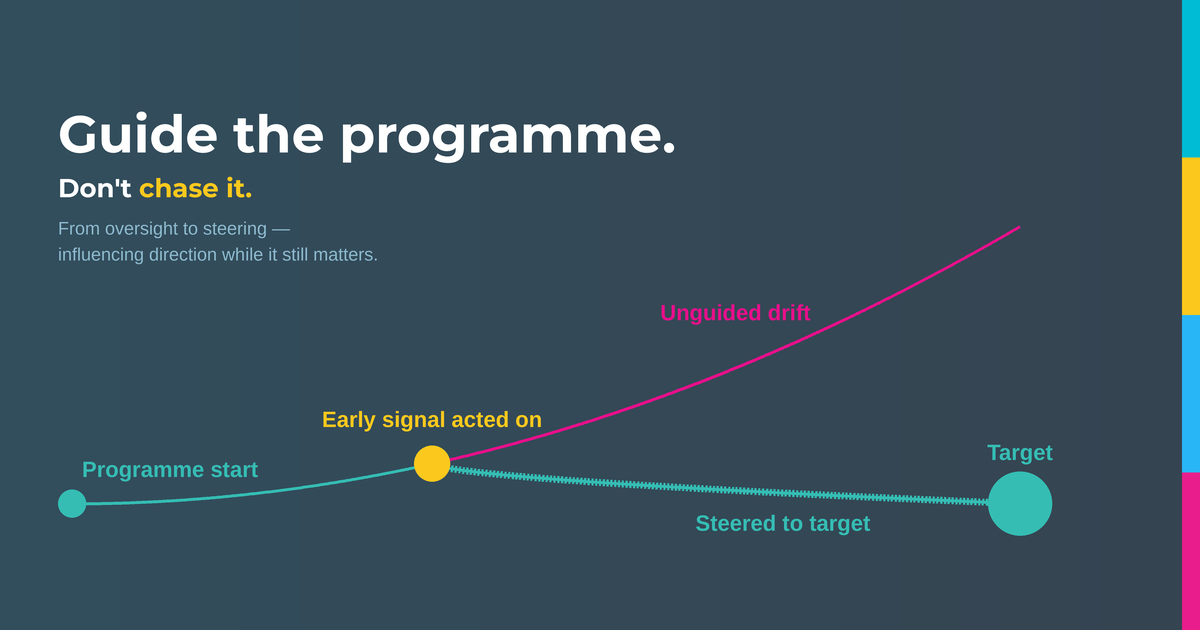
Instead of reacting after issues occur, teams can identify patterns as they develop. Similarly, instead of manually reconciling data, they can rely on aligned programme intelligence.
Moreover, rather than operating across disconnected cycles, teams can manage continuously across sourcing, booking, and performance. This is where connected accommodation infrastructure becomes critical.
Importantly, it does not replace existing stakeholders or systems. Instead, it brings them into alignment, supporting better collaboration across the ecosystem.
Reframing Programme Friction
When programmes feel reactive, when insight arrives too late, or when confidence depends on manual validation, the issue is often misunderstood.
It is not a reflection of the team. It is a reflection of the structure surrounding the programme. Because corporate accommodation programmes are not fixed processes. They are living systems. And they must be supported accordingly.