Back to list

Why Does Accommodation Data So Often Arrive Too Late to Matter?
In corporate accommodation programmes, data is not in short supply.
Spend reports arrive monthly. Rate audits surface inconsistencies. Booking data flows in from multiple sources. Supplier performance is tracked, measured, and reviewed. Leakage is identified, quantified, and explained.
On the surface, the industry appears well-informed.
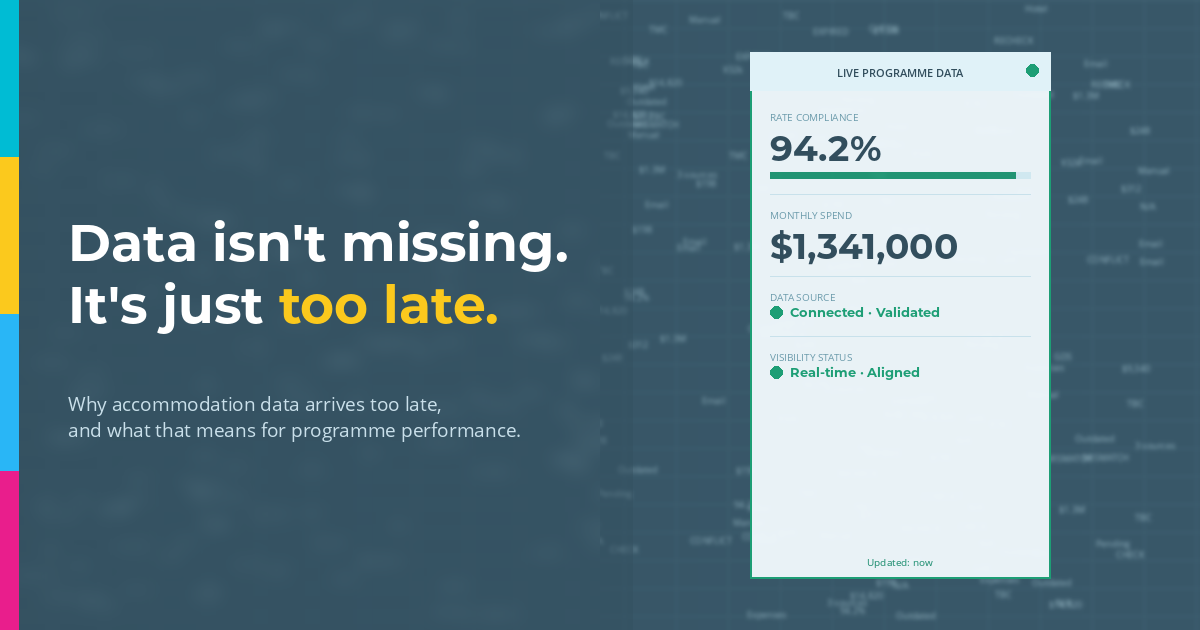
Yet beneath that surface sits a quieter, more consequential issue: most of this data arrives after the moment it could have influenced an outcome.
It tells us what happened — but rarely in time to change what is happening.
If There’s So Much Data, Why Does It Still Feel Incomplete?
Across corporate accommodation programmes, a consistent pattern emerges.
Reports are delivered after the month has closed. Rate discrepancies are identified only once bookings have already been made. Leakage becomes visible after budgets have been impacted. Performance reviews take place once decisions are already behind us.
In each case, the data is accurate. Often detailed. Sometimes extensive.
But it is also delayed.
And that delay changes the role data plays. Instead of guiding accommodation sourcing decisions, it becomes a tool for explanation — a way to understand outcomes rather than shape them.
Why Are Decisions Made in Real Time, While Data Looks Backwards?
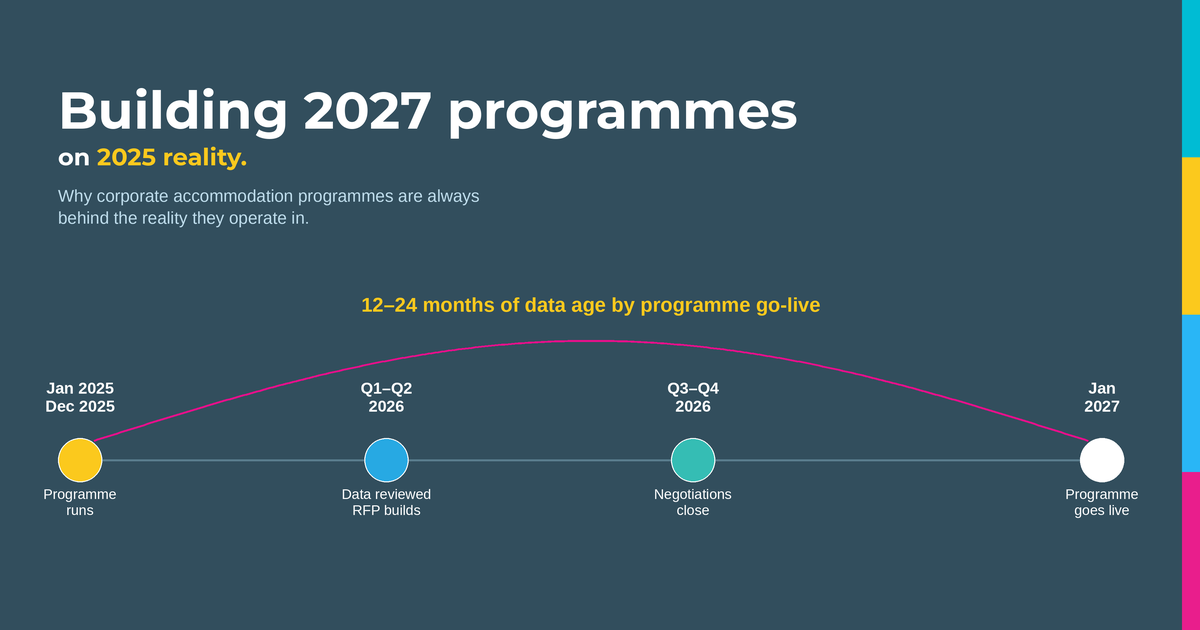
Accommodation programmes operate in a live environment. This reflects a broader structural shift, that accommodation programmes operate continuously rather than in defined phases, something explored in more detail in our earlier piece on programme structure.
Rates fluctuate daily. Availability shifts by the hour. Traveller behaviour adapts to convenience, pricing, and context. Market conditions move continuously, often without warning.
Yet the systems surrounding these programmes were not designed for this pace.
They were built to report, to reconcile, and to analyse retrospectively.
This creates a structural mismatch that is increasingly difficult to ignore:
decisions are made in the present,
while programme visibility arrives in the past.
It is not a failure of data quality. It is a question of timing.
What Does Delayed Visibility Actually Cost a Programme?
The impact of delayed data is not always dramatic, but it is cumulative.
Corporate accommodation programmes become reactive by design. Issues are investigated after they occur, rather than corrected while they are forming. Opportunities to address rate inconsistencies early are missed. Sourcing strategies remain fixed even as market conditions shift.
Over time, this reshapes behaviour.
Manual work increases. Confidence in programme data can erode. Supplier performance becomes harder to interpret with certainty. Decision-making slows, even as expectations continue to rise.
Importantly, this is not a reflection of capability. It is the natural outcome of operating within systems that were not built for continuous programme visibility.
Why Does This Timing Problem Persist Across the Industry?
The cause is not isolated to a single tool, platform, or stakeholder.
It is structural.
Different parts of the accommodation journey — sourcing, booking, distribution, and reporting — have evolved independently. Each generates data, but on its own timeline, within its own context, and often with its own interpretation.
The result is not a continuous flow of insight, but a series of snapshots.
Each snapshot offers a partial view. Each arrives slightly out of sync with the others. And most arrive after the moment where they could have meaningfully influenced a decision.
This is the reality reflected across the industry: fragmented systems producing fragmented programme visibility.
What Would It Mean to Treat Visibility as Continuous, Not Periodic?
If corporate accommodation programmes operate as continuous environments, visibility needs to evolve in the same direction.
Not limited to what happened last month, or what needs explaining at year-end.
But focused on what is happening now.
What is changing within a specific market. Where rate behaviour is shifting. Which accommodation sourcing decisions require attention today — not retrospectively.
This does not require more data.
It requires earlier data. More connected data. Data that aligns more closely with the moment where value is either protected or lost.
In practical terms, this means:
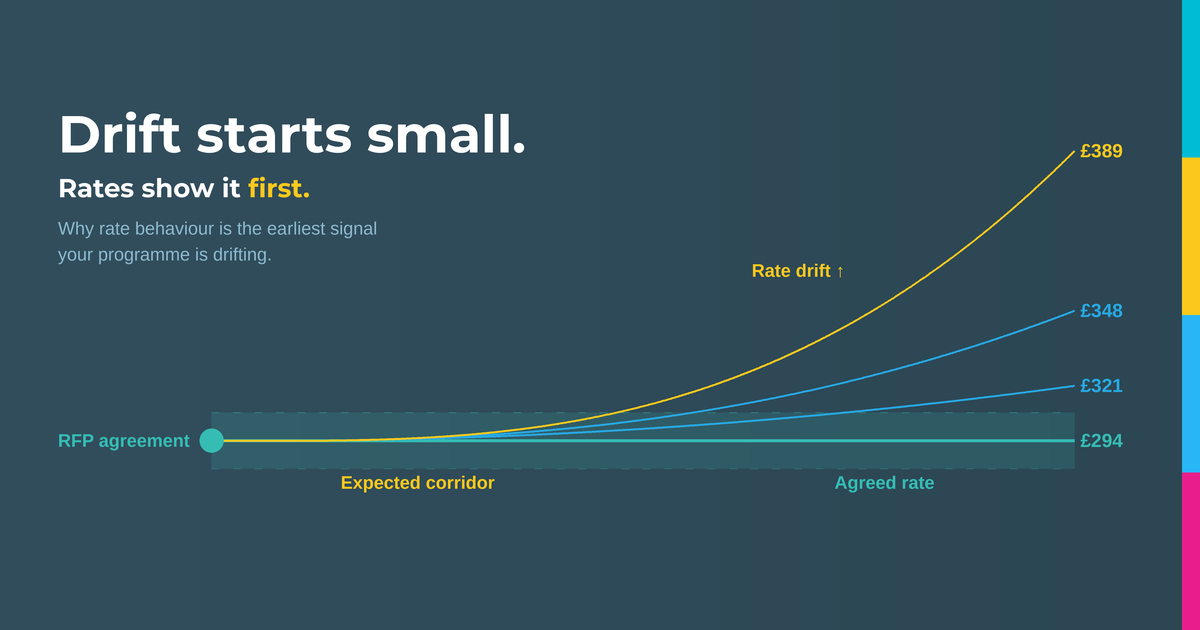
- Identifying rate drift before it impacts compliance
- Adjusting sourcing strategies within the active programme cycle
- Understanding supplier performance while decisions are still being made
- Enabling shared visibility between buyers and suppliers in real time
What Shift Is the Industry Beginning to Move Towards?
The direction of travel is becoming clearer.
The industry is not asking for additional reporting layers or more complex analytics. It is signalling a need for programme visibility that arrives closer to decision points — where it can influence outcomes, not just interpret them.
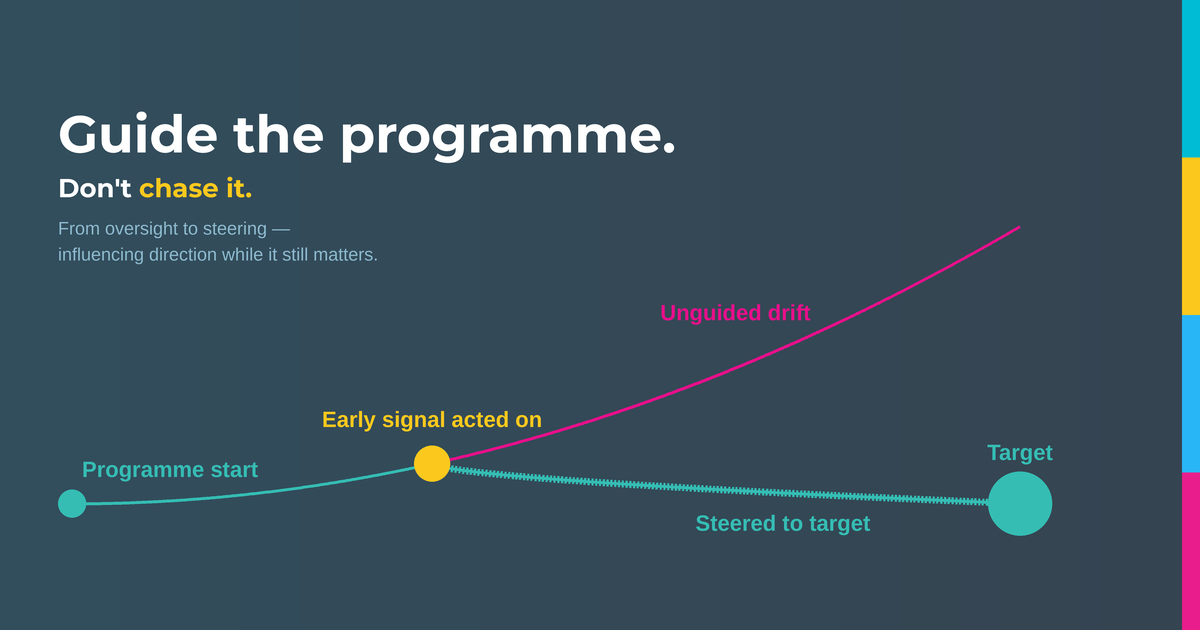
This reflects a broader structural shift already emerging across the ecosystem: from periodic oversight to continuous programme management.
It is not a dramatic transformation. It is a rebalancing.
A shift from retrospective reporting to real-time programme awareness.
What Happens When Data Arrives at the Right Moment?
When visibility aligns more closely with decision-making, the nature of programme management begins to change.
Programmes become more predictable, not because uncertainty disappears, but because it is surfaced earlier.
Teams can act with greater confidence, supported by insight that reflects the current state of the programme rather than historical outcomes.
Alignment improves — between buyers, suppliers, and internal stakeholders — because conversations are grounded in shared, timely understanding.
And importantly, the effort required to manage a programme begins to reduce.
Not through simplification of the environment, but through better timing of the information within it.
How Is This Shift Becoming Possible?
This move toward continuous programme visibility is not driven by additional reporting.
It is enabled by a different approach to programme intelligence.
One that connects accommodation sourcing, booking behaviour, and performance data earlier in the programme lifecycle — rather than analysing them separately after the fact.
By aligning data to decision points instead of reporting cycles, organisations can begin to move from retrospective analysis to active programme management.
This is where connected accommodation infrastructure plays a role — creating a more continuous flow of insight across the programme, and enabling earlier, more confident decision-making.
In the end, the challenge facing corporate accommodation is not a lack of data.
It is a question of when that data arrives — and whether it arrives in time to matter.