Back to list

Corporate Hotel Programme Leakage: Why It's a Design Problem, Not a Compliance Problem
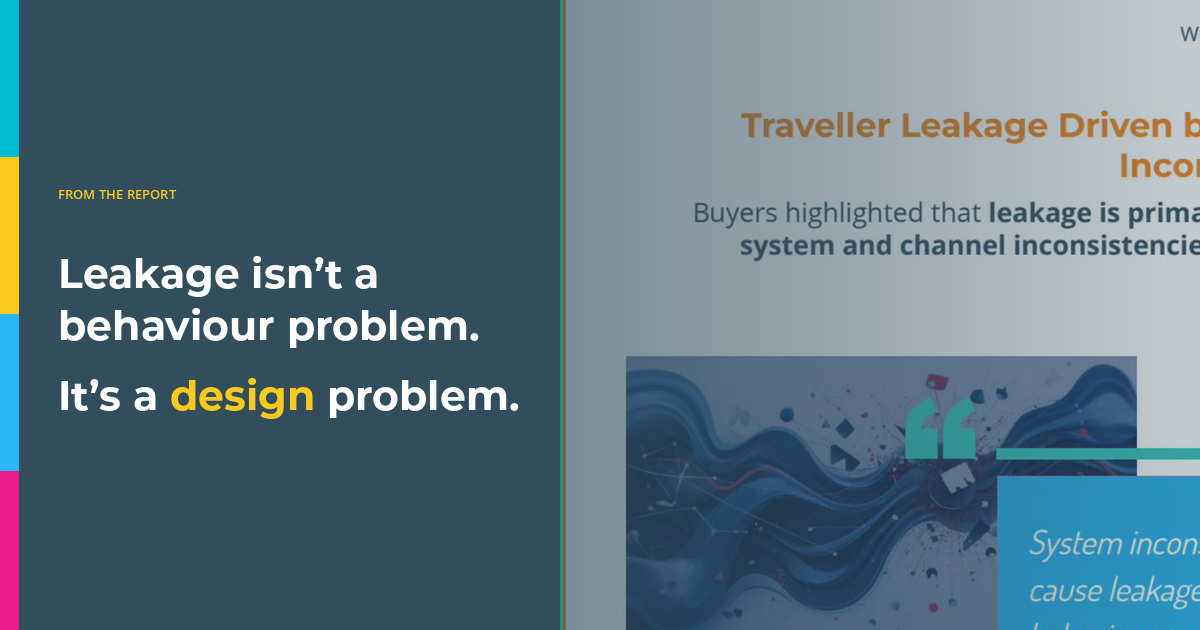
Most corporate travel programmes treat leakage as a traveller behaviour problem. The State of Corporate Accommodation found something different: leakage is primarily driven by channel and system design inconsistencies. This article explains why – and what a structural response looks like.
What Is Corporate Hotel Programme Leakage?
In corporate accommodation, leakage refers to bookings made outside approved programme channels, often through direct hotel websites or online travel agencies (OTAs), where negotiated corporate value may not be applied.
Leakage is one of the most frequently cited challenges in corporate accommodation programmes. It occurs when travellers book outside the approved channel – through OTAs, direct hotel websites, or unmanaged booking methods.
It is widely treated as a compliance issue, where travellers are seen as not following policy. The conventional response is policy reinforcement, warning messages at the point of booking, and managerial escalation.
However, the State of Corporate Accommodation surfaced a different pattern.
Across buyer commentary, leakage that persisted was rarely driven by deliberate non-compliance. Instead, it was driven by system behaviour and channel inconsistencies.
What Actually Causes Leakage in Corporate Hotel Programmes?
Buyers consistently pointed to channel and system inconsistencies, rather than traveller intent, as the primary drivers.
1. Negotiated Rates Not Visible in the Booking Tool
Corporate negotiated rates sometimes fail to appear in the online booking tool (OBT) at the time of search. When travellers cannot see the expected rate, they naturally explore external options.
2. Public Rates Appear Cheaper on OTAs
Public rates on OTAs can appear cheaper due to distribution costs, promotional pricing, or rate display differences. Even when the corporate rate provides more value, travellers respond to what appears cheaper.
3. Limited OBT Content in Certain Markets
In secondary markets or extended-stay categories, the corporate booking tool may simply offer limited property options, pushing travellers toward external platforms.
4. Direct Booking Channels Feel Simpler
Travellers often perceive hotel websites as faster, clearer, and easier to navigate than corporate booking tools.
5. Incomplete Property or Sustainability Information
When the OBT lacks details about amenities, sustainability credentials, or property information, travellers often leave the platform to validate details elsewhere.
Why Travellers Leak: A Rational Response to System Design
In each case, travellers are responding rationally to the experience presented at the moment of booking.
When negotiated value is not reliably visible, when content is incomplete, or when external platforms appear easier to navigate, behaviour adjusts accordingly.
These inconsistencies are often amplified in fragmented programme environments, where booking systems, rate loading, and reporting tools do not align – a structural constraint examined in our analysis of the disconnected data problem in corporate accommodation.
In this context, leakage is not rebellion – it is response.
Why the Compliance Narrative Still Dominates
Compliance Is Easier to Measure
Compliance is visible. Infrastructure gaps are not.
It is far easier to identify a booking outside policy than to diagnose why the booking system failed to support policy in the first place.
Behaviour Is Easier to Blame Than Systems
The compliance framing isolates the outcome, a booking outside the tool – and assigns responsibility to the individual.
A structural explanation requires acknowledging that:
-
negotiated rates may not be loading correctly
-
channel pricing may be misaligned
-
the booking experience may be weaker than consumer platforms
That conclusion is less comfortable, but it is closer to what the data indicates.
Persistent leakage despite strong policy communication is rarely a behavioural failure. It is usually a design signal.
A Design-Led Approach to Reducing Corporate Travel Leakage
A design-led approach begins with a simple assumption: travellers respond logically to the systems they are given.
Instead of intensifying enforcement, organisations examine the booking architecture itself.
Three structural layers consistently emerged in 2025 buyer discussions.
1. Rate Integrity at the Point of Booking
Negotiated rates must load, display, and behave consistently across channels.
If travellers cannot reliably see negotiated value, policy enforcement cannot compensate.
2. Complete and Accurate Content Coverage
Corporate booking tools must fully represent:
-
secondary markets
-
extended-stay accommodation
-
sustainability information
-
property amenities
Incomplete content drives travellers to validate information externally – which often leads to leakage.
3. A Competitive Booking Experience
Corporate booking tools must compete on clarity and usability, not just compliance messaging.
If direct channels are materially simpler, leakage becomes predictable.
A design-led response does not eliminate policy. It simply reduces the need to rely on policy as a corrective mechanism.
Why This Distinction Matters for Corporate Travel Programmes
When leakage is framed as a compliance problem, the response becomes surveillance and escalation.
When leakage is framed as a design problem, the response becomes system alignment.
The difference is significant.
Compliance pressure may temporarily reduce visible leakage, but structural improvements address the underlying causes.
Recognising leakage as a system response rather than a behavioural exception shifts the strategic conversation:
-
from enforcement to architecture
-
from correction to prevention
Conclusion: Fixing Leakage at the System Level
Leakage that persists despite clear policy communication is rarely accidental. It is usually the product of:
-
channel inconsistency
-
fragmented distribution
-
booking environments that fail to surface negotiated value
Industry signals throughout 2025 were consistent: travellers behave rationally within the systems they are given.
If those systems do not align negotiated value, content clarity, and booking simplicity, behaviour will adjust accordingly.
Addressing leakage at the design level produces more durable outcomes than enforcement alone.
The State of Corporate Accommodation explores this structural reframing in greater depth and reflects the direction buyers and hotels are already acknowledging.