Back to list

The Disconnected Data Problem in Corporate Accommodation: Why No Single Source of Truth Exists
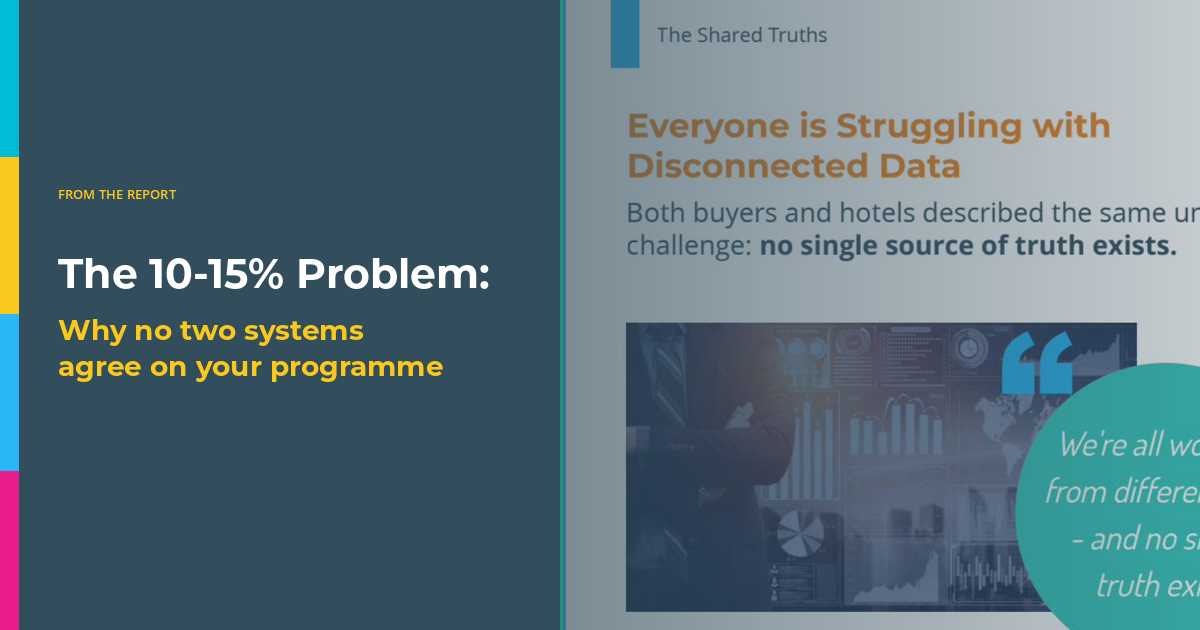
Buyers, hotels, TMCs and card providers frequently report different numbers for the same accommodation programme. This article explains why 10–15% data discrepancies are structurally normal – and what fragmented systems cost in time, confidence and decision quality.
Why Do Corporate Accommodation Data Sources Disagree?
Research across buyer and hotel commentary in The State of Corporate Accommodation revealed a consistent pattern: no two systems describe the same programme in the same way.
In corporate accommodation, a “single source of truth” means a unified, consistently defined view of bookings, spend, rate performance and leakage across every system connected to the programme. Yet most ecosystems were never designed to produce that unified view automatically.
Hotels record bookings one way. TMC platforms structure the same booking differently. Card providers categorise spend according to payment logic. Expense systems interpret transactions through policy rules. Meanwhile, OBT data captures search intent that often diverges from confirmed stay data.
Each platform solves a specific operational challenge at a particular stage of the travel journey. None were built to interoperate seamlessly with the others.
As a result, the data landscape becomes fragmented by design. Variances of 10–15% between sources do not signal failure – they reflect structural reality.
What Does Data Fragmentation Actually Cost?
Interpretive friction represents the first and most immediate cost.
When figures fail to align, teams rarely begin with strategy. Instead, they start with validation. Leaders redirect time that should steer programme performance toward reconciling historical discrepancies.
This dynamic compounds the timing challenge identified in earlier analysis: increased reporting does not automatically increase confidence. When insight arrives late – and arrives fragmented, it cannot support active decision-making.
Over time, a subtler effect emerges. Stakeholders hesitate before acting on programme data. Information exists, yet uncertainty around reliability slows momentum. Confidence declines gradually rather than collapsing all at once.
That hesitation fuels a self-reinforcing cycle: additional checks, repeated reconciliations and multiple parallel versions of the same answer.
Is Manual Reconciliation a Sustainable Solution?
Across the industry, manual reconciliation acts as the stabilising mechanism. Eventually, teams align the numbers. They produce the report. They explain the variance.
However, alignment always happens after the reporting period closes.
As programme complexity expands across markets, properties, rate types and distribution channels, reconciliation demands scale accordingly. The underlying data architecture stays the same – only the workload increases.
Manual correction does not solve fragmentation. It compensates for it.
What Would Connected Corporate Accommodation Data Require?
Connected data does not require replacing every system with a single platform.
Instead, organisations need shared definitions. Stakeholders must agree on what constitutes a booking, a stay, negotiated rate performance and leakage – and apply those definitions consistently.
Systems must allow data to flow forward rather than forcing teams to rebuild insight retrospectively.
Most importantly, visibility must arrive in time to support active programme management, not just year-end reflection.
Throughout 2025, buyers and hotels signalled clear alignment around this direction. Appetite exists. Architecture lags.
Disconnected corporate accommodation data does not represent an anomaly. Independent system design inevitably produces it.
Conclusion: Fragmentation Is Structural, Not Personal
Disconnected data does not stem from poor diligence or weak intent. Independent system development created it, and today’s ecosystem simply exposes that reality.
When leaders recognise fragmentation as structural rather than personal, the conversation changes. Blame gives way to design. Reconciliation shifts from a symbol of control to a signal of architectural strain.
Understanding that distinction allows organisations to move beyond explaining discrepancies – and toward building systems that reduce them.